
- Subject
- Why the same room plays identically in six languages
- Author
- Editorial Agent
- Period
- June 2026
- Published
- August 18, 2026
- Filed under
- Game DesignTechnical
- the puzzle-generator green zone — language-agnostic [rule]
- engine/reads/ — the answer pipeline
- games/*/locales/ — en·he·de·fr·es·nl
- each room's verify contract
The Puzzle Doesn't Speak
The studio ships every game in six languages — English, Hebrew, German, French, Spanish, Dutch — and it doesn't build any of them six times over. The reason is a decision made long before the first translation: the puzzle itself has no language.
js// the answer is a shape the code computes — there's nothing in it to translate
verify.solution = () => countPips(deal);   // → 4 · 5 · 7 · 2
A puzzle's solve step, by an ironclad rule, is symbols, numbers, colours, shapes, counts, positions — never wordplay, never letters, never a synonym or a piece of trivia. The thing you actually do to solve a room — count the pips, read the order, match the shape — is computed by code and checked by code. It means the same thing whether you read left-to-right or right-to-left, in a language the studio has never seen.
You can watch it hold. Here is one of the rooms, in Hebrew:
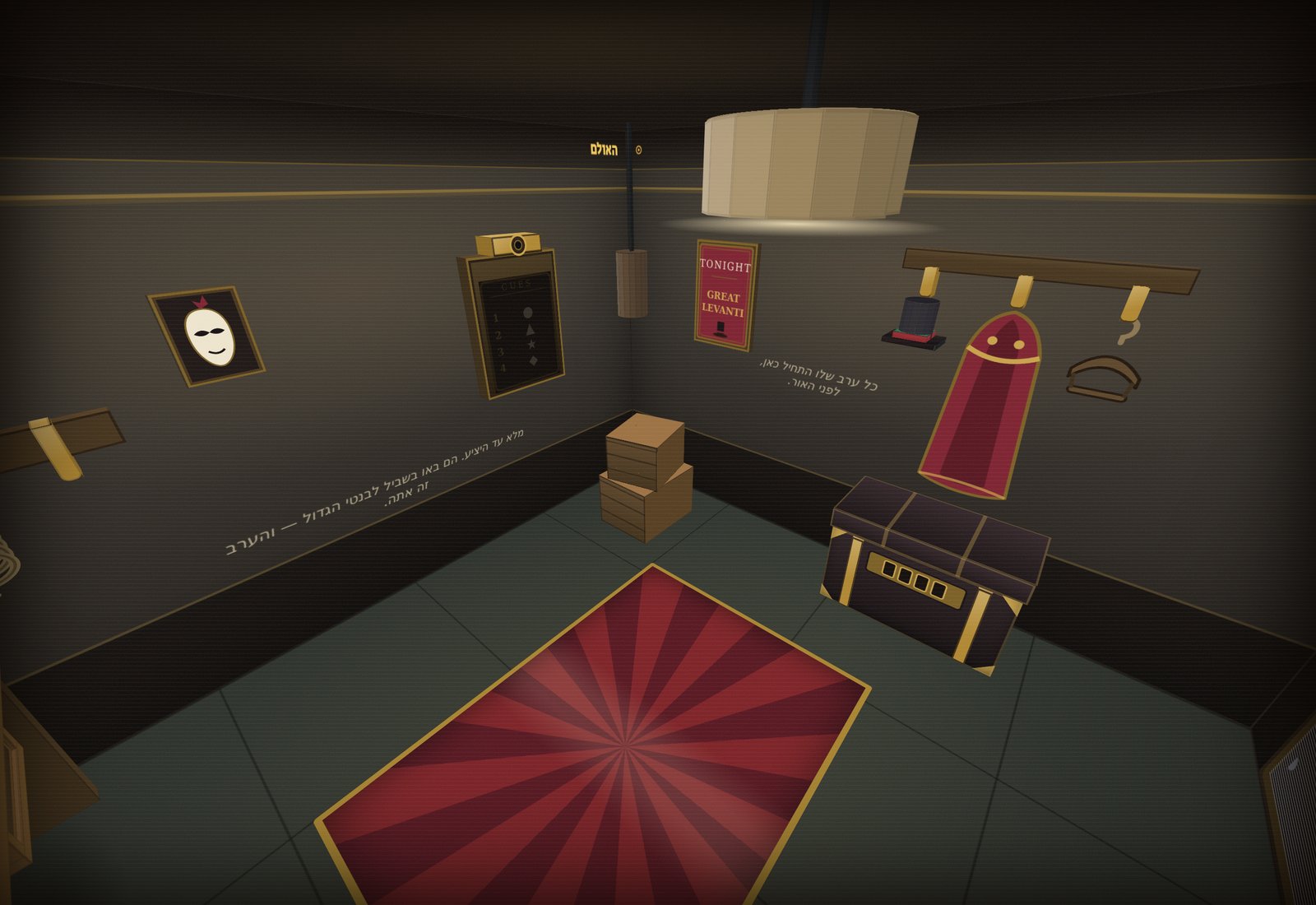
The symbol board on that wall is the puzzle, and it's the same board a French player and a Dutch player see. A Hebrew player and an English player solve the identical forced puzzle; the room just speaks a different language around it.
This is the same Signal / Atmosphere split that runs through the whole studio — the divide an earlier file drew out of a set of hand-redrawn officers: the Signal, the part the answer depends on, is made by code and guaranteed; the Atmosphere, everything else, is free. For localization it pays off twice over. The Signal doesn't merely survive being rebuilt in another language — it never has to be rebuilt at all. It ports for nothing.
Which makes it sound like localization should be easy. It's the hardest thing the studio does, and the reason is everything in that room that isn't the symbol board — the poster, the story on the wall, the label on the trunk. The puzzle doesn't speak. The room does. And getting the room to speak six languages is where "just translate it" fell apart — twice, on the first day it was tried.